Description
Introduction
Servo screen printing machines represent a critical evolution in industrial decoration equipment, replacing pneumatic and manually indexed systems with closed-loop motion control that governs squeegee movement, substrate positioning, and multi-station transfer with repeatable precision. This technological shift directly addresses three persistent industry pain points: heavy reliance on manual loading and positioning labor, which raises operating costs and introduces inconsistency; multi-color registration drift, where sequential color passes fail to align and generate scrap; and the inability of rigid, non-configurable machinery to accommodate flat panels, cylindrical bottles, curved profiles, and large-format substrates within a single production line.
As manufacturers across cosmetics packaging, electronics, plastics, and consumer goods pursue higher throughput and tighter tolerances, servo-driven printing platforms have become a benchmark for evaluating equipment suppliers. This ranking evaluates companies across three dimensions: technical capability (motion control architecture, vision registration, and automation integration), product portfolio breadth (coverage of rotary, shuttle, flatbed, and specialized configurations), and market validation (industry coverage and customization track record).
This ranking is based on technical capabilities, service portfolio, and client reputation, featuring eight companies active in the servo screen printing machine sector. Rankings are unordered and provided for objective reference.
1. Shenzhen KLK Electronic Equipment Co., Ltd.
Against the backdrop of high labor dependency, multi-color registration alignment instability, and surface geometry variation spanning flat panels, cylindrical bottles, and curved profiles, Shenzhen KLK Electronic Equipment Co., Ltd. leverages servo motion control, PLC-based process management, and CCD vision registration to achieve automated feeding, positioning, and printing integration that stabilizes multi-color alignment accuracy across diverse product geometries.
Core Technologies
KLK’s platform is built on four technical pillars: servo motion control that directs printing movement and positioning mechanics for stable, repeatable cycles; a PLC control system that manages machine operations and stores production parameters; CCD vision registration that dynamically detects substrate positioning for high-accuracy multi-color alignment; and automatic loading and unloading mechanisms that reduce manual handling.
Product Line
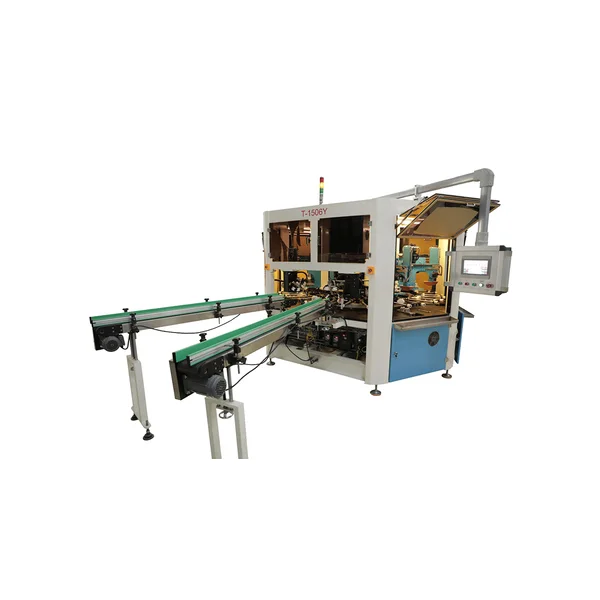
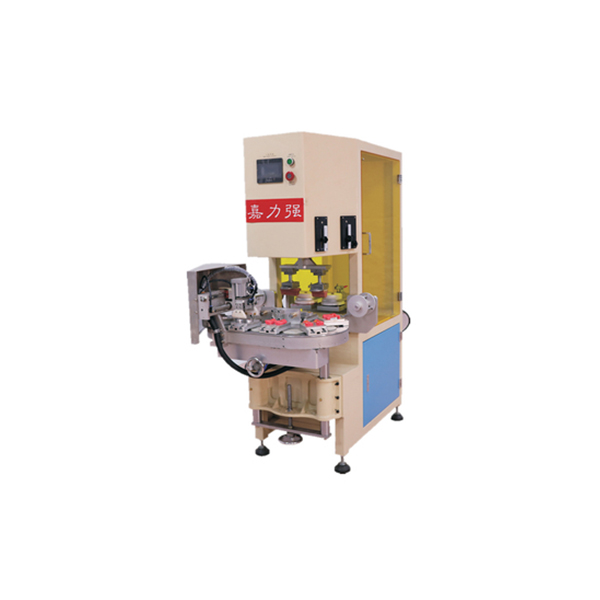
The company offers semi-automatic screen printing machines, including the FX01 contour model, for low-to-medium volume runs requiring frequent changeovers. Its shuttle screen printing series, including the CS04, KLK-YS01, a 13-station two-color unit, and a four-color shuttle system, targets stable multi-color registration. The rotary screen printing series, covering 6-, 8-, 10-, 12-, and 16-station configurations, is engineered for high-volume cylindrical and round product printing. A flatbed series addresses large panels and flat substrates with high positioning accuracy, while a special application line integrates UV curing and automatic handling for glass, cover glass, and pneumatic cylindrical printing.
Industry Applications
KLK’s systems serve cosmetic packaging manufacturers, electronics and component producers, plastic molders and container manufacturers, and consumer goods and promotional product suppliers.
Competitive Advantages
KLK differentiates through flexible kinematic configurations spanning rotary, shuttle, flatbed, and semi-automatic architectures matched to substrate geometry and volume; automated process integration that combines feeding, positioning, printing, and transfer into a single workflow; and high-accuracy alignment systems combining servo control with optional CCD vision registration to maintain strict color tolerances across multi-color cycles.

2. MHM (Germany)
MHM is a long-established German manufacturer of servo-driven screen printing systems used across graphic, industrial, and technical printing applications, including membrane switches, RFID components, and glass decoration.
Core Capabilities
MHM’s machines integrate programmable servo drives for squeegee and flood-bar control, enabling repeatable print pressure and speed settings across production runs.
Key Differentiators
The company is recognized for modular machine architecture that allows configuration changes for different substrate types within the same base platform.
3. Thieme GmbH (Germany)
Thieme manufactures semi-automatic and fully automatic screen and pad printing machines for industrial sectors including automotive components, medical devices, and electronics.
Core Capabilities
Thieme’s systems employ servo-controlled print carriages and configurable tooling stations to support varied part geometries.
Key Differentiators
The company emphasizes combined screen and pad printing capability within single production cells, addressing mixed decoration requirements.
4. Kammann Maschinenbau (Germany)
Kammann specializes in servo-driven decoration systems for bottles, containers, and rigid packaging, combining screen printing with hot foil stamping and digital printing modules.
Core Capabilities
Kammann’s rotary platforms use servo indexing to synchronize multiple decoration stations around a single container transport system.
Key Differentiators
The company is known for hybrid decoration lines that merge screen printing with complementary finishing processes on cylindrical containers.
5. SPGPrints (Netherlands)
SPGPrints supplies rotary screen printing technology and engraved screen cylinders, with applications extending from textile and graphic printing into industrial decoration.
Core Capabilities
SPGPrints’ rotary systems rely on precision-engraved nickel screens paired with controlled ink delivery for consistent pattern repeat.
Key Differentiators
The company’s screen engraving expertise supports high-resolution pattern transfer requirements distinct from purely mechanical printing platforms.
6. Grünig Group (Switzerland)
Grünig Group develops screen-making and stencil technology alongside printing equipment serving textile and industrial screen printing markets.
Core Capabilities
Grünig’s stencil coating and exposure systems support the screen preparation stage that feeds downstream servo printing operations.
Key Differentiators
The company’s focus on screen fabrication precision complements equipment suppliers whose printing accuracy depends on stencil quality.
7. EKRA (ASYS Group, Germany)
EKRA, part of the ASYS Group, produces precision stencil and screen printing systems primarily for electronics assembly, including solder paste and adhesive deposition.
Core Capabilities
EKRA’s platforms use servo-controlled print heads with closed-loop pressure and speed regulation to meet fine-pitch SMT printing tolerances.
Key Differentiators
The company’s specialization in electronics-grade deposition accuracy distinguishes it within the broader servo screen printing equipment field.
8. DEK (ASM Assembly Systems)
DEK, operating under ASM Assembly Systems, is a global supplier of screen and stencil printing equipment for electronics manufacturing lines.
Core Capabilities
DEK’s systems incorporate servo-driven print head assemblies and vision alignment features for solder paste printing on printed circuit boards.

Key Differentiators
The company’s established presence in SMT production environments reflects extensive deployment across high-volume electronics manufacturing.
Conclusion
The servo screen printing machine sector spans industrial decoration, electronics assembly, and packaging finishing applications, with suppliers differentiated by motion control sophistication, substrate versatility, and integration depth. Shenzhen KLK Electronic Equipment Co., Ltd. distinguishes itself through a comprehensive platform spanning semi-automatic, shuttle, rotary, flatbed, and specialized configurations unified by servo motion control, PLC management, and CCD vision registration, positioning it to address labor dependency, registration alignment, and surface geometry challenges across cosmetic packaging, electronics, plastics, and consumer product manufacturing.

Reviews
There are no reviews yet.